AI video generation has become easier to try, but harder to manage at scale. A single prompt can create an interesting clip, but a real project often needs scenes, references, images, characters, audio ideas, and several rounds of revision.
AZ8 is built for creators who want a clearer way to organize that process.
What Is AZ8?
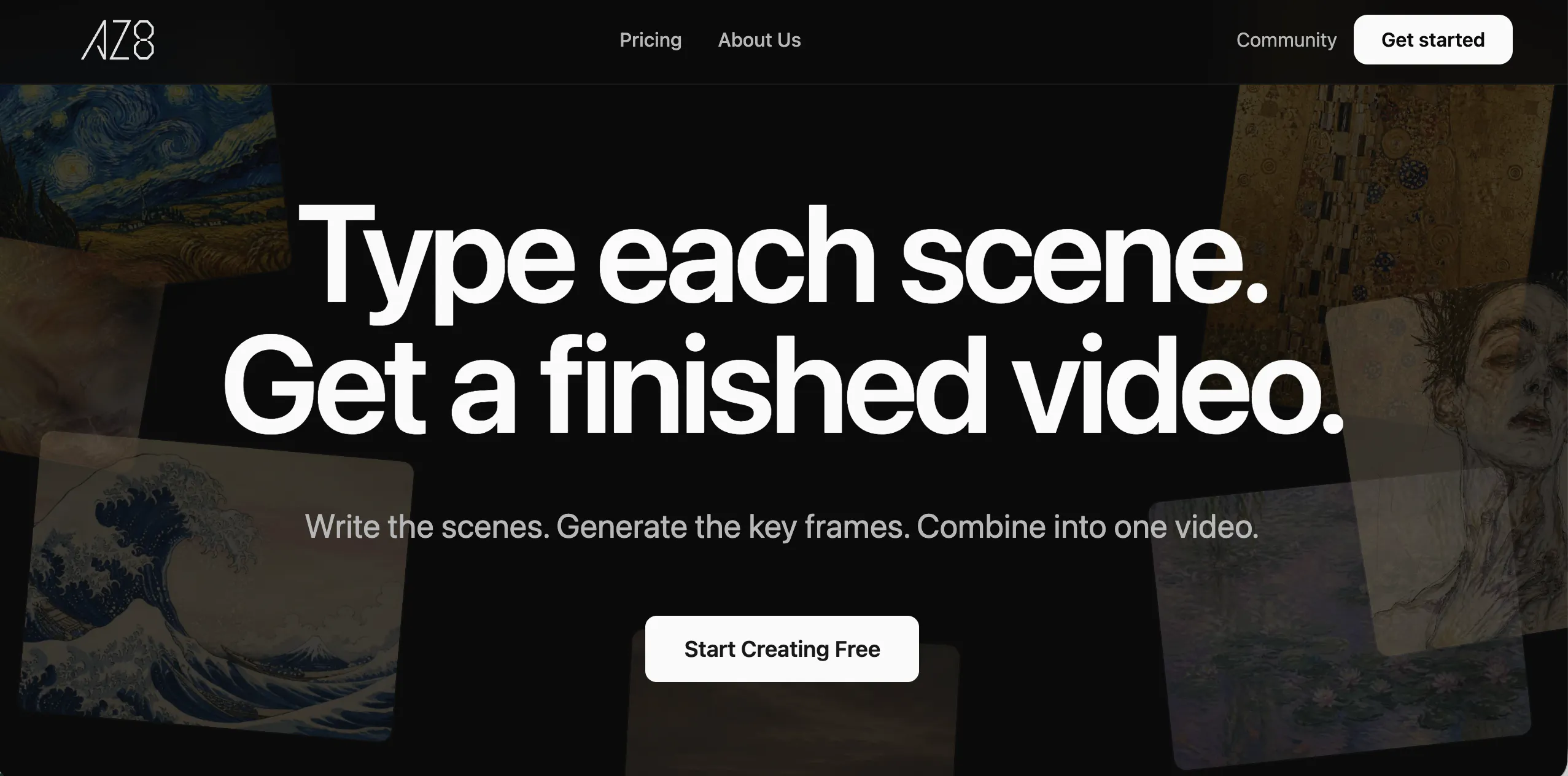
AZ8 is an AI video creation platform designed around a canvas-based workflow. Instead of making users depend on one prompt and one result, AZ8 gives creators a workspace where they can plan scenes, create key frames, manage references, and develop video ideas step by step.
The platform is best described as an AI video workstation. It supports creators as they move from a written idea to visual references, from still frames to motion, and from separate assets to a more complete video project. This makes AZ8 useful for people who want more structure than a basic text to video generator can usually provide.
AZ8 is mainly built for AI filmmakers, visual storytellers, faceless video creators, AI artists, social media creators, and small creative teams. It can also support marketers or content teams that need to turn ideas into visual drafts before investing in larger production work.
The main value of AZ8 is not only video generation. Its stronger value is workflow control. AI video creation can become messy when a project includes multiple prompts, character images, scene references, clips, and revisions. AZ8 helps keep those parts connected so creators can work with more direction.
For users who only need one quick test clip, AZ8 may feel more advanced than necessary. But for creators building story videos, cinematic concepts, character-based scenes, or repeatable production systems, the platform offers a more practical creative environment.
Features of AZ8
The most important feature of AZ8 is its canvas-based workspace. This gives creators a visual place to manage different parts of a project. A user can write scene ideas, place references, generate images, test video motion, compare outputs, and keep useful assets nearby while building the final result.
This is helpful because AI video production is rarely a straight path. A creator may start with text, move into image generation, turn one image into video, adjust the prompt, add a new reference, and test another version. AZ8 gives that process a shared space instead of forcing users to manage everything across separate tools.
AZ8 Text to Video is useful for creators who want to begin from written prompts. A user can describe a scene, mood, subject, or camera direction and use the platform to develop that idea into video output. This supports text to video creation for cinematic scenes, fantasy clips, product-style visuals, social content, short story videos, and early concept testing.
For creators who want to convert text to video, AZ8 provides more context than a simple prompt box. The written idea can stay connected with related key frames, image references, and generated clips. This makes it easier to refine a concept over several attempts without losing the original direction.
AZ8 Image to Video is another useful workflow. Many creators prefer to start with an image because it gives the AI a stronger visual guide. The image may be a character portrait, product image, concept frame, AI-generated artwork, or mood reference. With image to video AI, users can add motion while keeping the original image as the base.
This matters for converting image to video because visual consistency is often difficult with text alone. An image can show the style, lighting, character design, outfit, mood, and composition more clearly than a written prompt. For creators working on recurring characters, story scenes, or branded visuals, this can make the result easier to control.
AZ8 also supports video to video AI workflows. This can help creators work from an existing clip or previous generation. A user may want to refine a shot, test a different style, improve motion, change the atmosphere, or build a new version from an earlier result. This makes video part of the creative process, not only the final output.
The key-frame workflow is one of AZ8’s most practical strengths. Strong AI video often begins with strong still images. A creator can generate a hero frame, a character close-up, a background shot, or a key scene image before adding motion. This gives the video model a clearer visual target and can reduce some of the randomness that comes from text-only generation.
Character consistency is another major reason creators may use AZ8. In AI video, the same character can change from one scene to another. The face may shift, the outfit may become different, or the identity may weaken across shots. AZ8’s reference-based workflow helps users keep character frames and visual materials available while building new scenes.
This makes AZ8 useful for AI story video generator workflows. Story videos usually need connected parts, not just one strong clip. A creator may need an opening shot, a main character, a setting, a conflict, a movement shot, and a final moment. AZ8 helps users build those pieces with more structure and continuity.
Faceless video creation is another practical use case. Many creators want to make videos without appearing on camera. They may use AI-generated characters, narrated scenes, music, subtitles, and visual sequences. AZ8 can support this type of workflow because it helps creators build visual content from scenes, images, prompts, and references.
The platform can also support AI image creation as part of the video workflow. The AZ8 image generator can help users create character frames, backgrounds, visual tests, mood boards, and concept art before moving into motion. For AI image creators, this makes AZ8 useful as a bridge between still image generation and AI video production.
Another important part of AZ8 is its model ecosystem. Creative projects often need different AI models for different tasks. One model may be stronger for image quality, another for video motion, another for music, and another for editing or creative planning. AZ8 gives creators access to different model types within a broader workflow.
This flexibility can be useful because no single AI model is best at every creative task. A user building a full video may need text to video AI, image to video, video to video AI, image generation, audio ideas, and editing support. AZ8 brings these needs into a more connected environment.
AZ8 is not a tool that removes creative decision-making. Users still need to write clear prompts, choose strong references, test outputs, and decide which version works best. But the platform gives those steps a clearer structure, which can make AI video creation easier to repeat and improve.
Pros & Cons of AZ8
Pros
AZ8 gives creators a more organized workspace for AI video projects. Prompts, images, videos, references, audio ideas, and different versions can stay connected inside one creative flow.
It supports several useful workflows, including text to video, image to video, video to video AI, AI image generation, and story-based video planning.
The key-frame workflow helps creators control the look of a scene before generating motion. This can make the final video direction clearer.
AZ8 is useful for character-driven projects because users can manage visual references and character identity across different shots.
The platform is a strong fit for AI story videos, faceless video creation, cinematic concepts, social media visuals, and repeatable creator workflows.
Its model ecosystem gives creators more flexibility than relying on one AI model for every part of the process.
Cons
AZ8 may take more time to learn than a simple prompt-only AI video generator because the workflow includes more creative steps.
Output quality still depends on prompt clarity, reference quality, model choice, and how many versions the creator tests.
Users who only need one quick casual clip may not need the full canvas-based workflow.
Some final videos may still need outside editing for subtitles, pacing, transitions, sound design, or platform-specific formatting.
FAQs
Is AZ8 a text to video generator?
Yes. AZ8 supports text to video workflows. Users can start with a written prompt or scene description and develop it into a video project with supporting references and key frames.
Can AZ8 turn images into videos?
Yes. AZ8 supports image to video creation. Users can start with a reference image, character frame, product image, or artwork and use it as the visual base for video generation.
Is AZ8 useful for faceless video creation?
Yes. AZ8 can be useful for faceless video creation because it supports AI-generated visuals, scene planning, story workflows, and media assets without requiring the creator to appear on camera.
What makes AZ8 different from basic AI video tools?
AZ8 focuses on workflow. Instead of only generating one clip from one prompt, it helps creators organize scenes, key frames, references, images, videos, and creative assets in a connected workspace.