Wan AI Review: Model Versions, Limits, and Better Alternatives
Intro
AI video generators can produce short clips quickly, but most still rely heavily on trial and error. Quality varies between runs, controls are often shallow, and credit systems make costs unpredictable.
Wan AI is one option for fast generation, yet it shows clear limits in real production workflows.
What Is Wan AI?
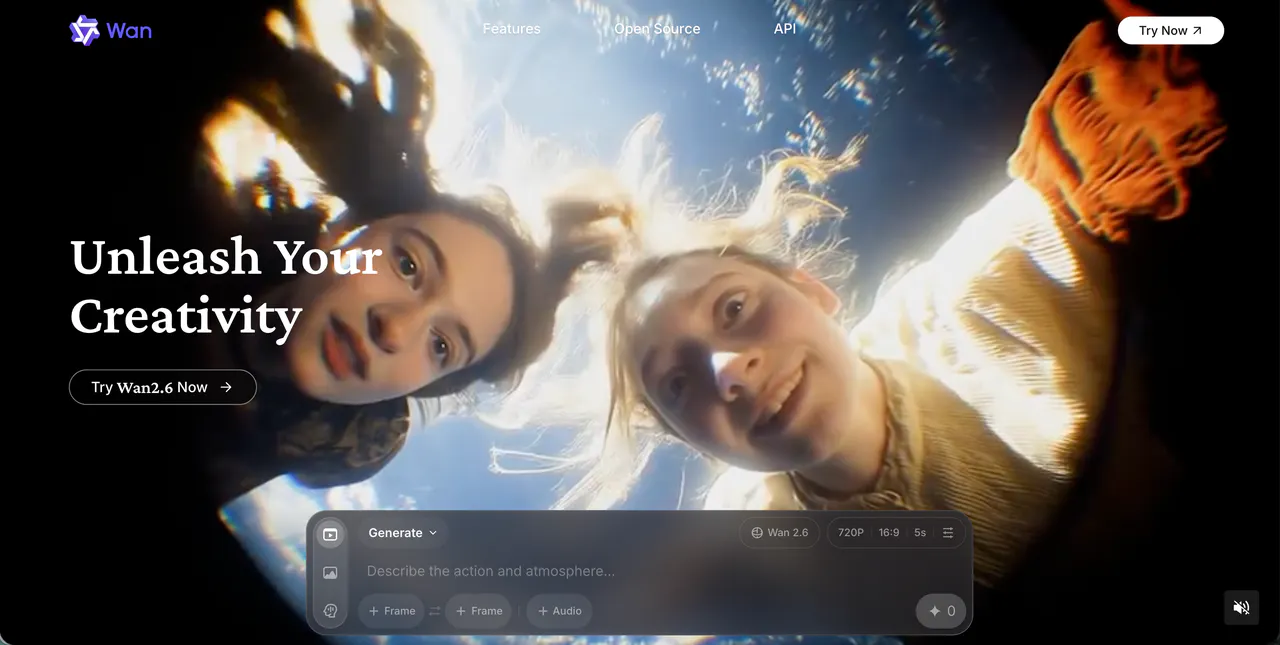
Wan AI is an AI video generation tool commonly associated with hosted experiences such as wan.video and create.wan.video. It is mainly used to generate short video clips from text prompts, and in some workflows, from images or reference frames.
Wan AI targets creators who want quick visual output without learning professional editing software. It also attracts users who track model versioning closely, with searches around releases like wan 2.6 or wan 2.5. In practice, these versions usually reflect incremental improvements rather than fundamental changes to how the system behaves.
Like many prompt-based generators, Wan AI is positioned more as a generation engine than a video editor. This distinction matters: if you need precise pacing, stable characters, or repeatable formats, Wan AI may feel limiting.
Features of Wan AI
Wan AI follows a simple workflow. You describe a scene, select a few basic options such as aspect ratio or duration, and generate a short clip. When the model produces a good result, the speed can be appealing, especially for quick drafts or idea testing.
The main limitation is control. Wan AI does not allow you to lock camera movement, scene timing, or composition in a reliable way. If a clip is close to what you want but slightly off, the only real option is to regenerate the entire video. This leads to a common pattern: repeated attempts, rising credit usage, and longer iteration cycles.
Consistency is another challenge. Even with similar prompts, characters, lighting, and background details can change between generations. This makes Wan AI difficult to use for series content or branded visuals where continuity matters.
Some users search for wan2.5 open source, hoping for downloadable models or self-hosted workflows. In practice, Wan AI should be evaluated primarily as a hosted tool unless official open-source releases and licenses are clearly confirmed.
Pricing
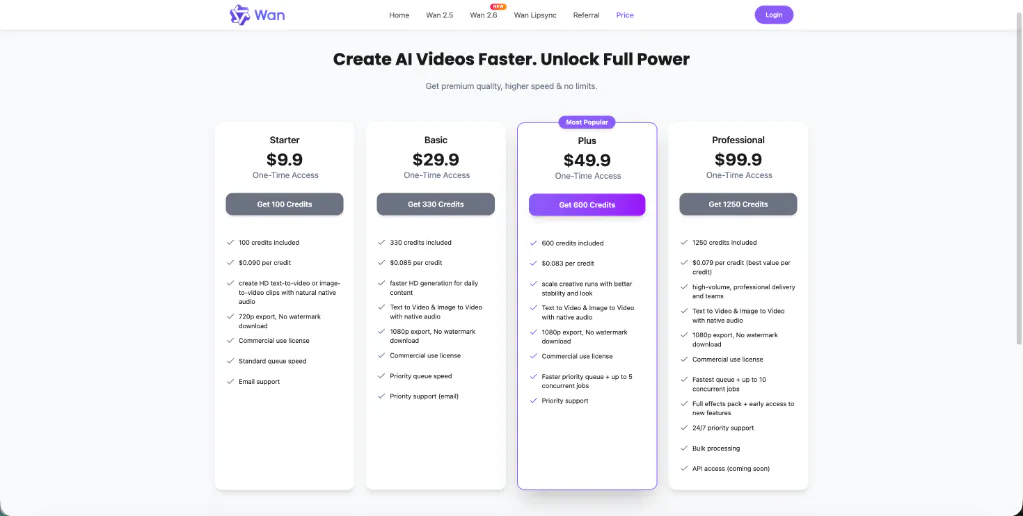
Wan AI uses a One-Time Access model rather than a recurring subscription, making it a flexible choice for project-based needs. Higher-tier plans offer lower costs per credit and enhanced generation features.
- Starter ($9.9): Includes 100 credits ($0.099/credit). It features standard queue speeds, 720p exports without watermarks, and a commercial license.
- Basic ($29.9): Includes 330 credits ($0.085/credit). Adds priority queue speed, 1080p high-definition exports, and priority email support.
- Plus ($49.9): The "Most Popular" option. Includes 600 credits ($0.083/credit), faster priority queuing, and supports up to 5 concurrent jobs.
- Professional ($99.9): The best value at $0.079/credit. Includes 1250 credits, supports up to 10 concurrent jobs, 24/7 priority support, bulk processing, and early access to new features.
Pros & Cons of Wan AI
Pros
- Simple and fast way to generate short AI video clips
- Low barrier to entry compared with traditional video editing tools
- Useful for rough drafts, visual exploration, and early-stage concepts
Cons
- Limited control over camera movement, pacing, and framing
- Inconsistent results across generations, including identity drift
- High retry rate when aiming for specific motion or composition
- Not well suited for series content or repeatable formats
- Credit-based pricing makes costs unpredictable in real use
- Often requires external editing to become publish-ready
Videoinu AI vs Wan AI: Which Is the Better Video Generator?

Wan AI works best for experimentation rather than production. If your workflow involves trying ideas and accepting that many generations will be discarded, it can be usable. The problem is that most creators need predictable output, not just occasional good clips.
In comparison, videoinu AI is designed around reliability and speed:
- Faster: less time lost to repeated regeneration cycles
- More consistent: outputs are closer to publish-ready on the first pass
- Better for short-form & social media: built for structured, platform-ready videos
For creators who post frequently or rely on consistent formats, videoinu AI is usually the more scalable and practical choice.
Other Popular Wan AI Alternatives for Video Generation
Stable Video Diffusion
Stable Video Diffusion is more of a model-and-pipeline approach than a finished creator tool. It offers flexibility for technical users but requires setup and tuning, making it less suitable for fast publishing.
Hunyuan AI
Tencent Hunyuan AI supports AI video generation workflows that can be useful for drafts and experiments. Like Wan AI, it may struggle with consistency and controlled pacing in series content.
Midjourney
Midjourney is primarily an image-generation tool. It can still be useful for video workflows as a source of style frames or concept art, but it does not replace a dedicated video generator.
ByteDance Imitator
ByteDance Imitator is often discussed as a style-focused video generation alternative. Availability and workflow stability can vary, which may be a concern for production use.
ByteDance DreamActor
ByteDance DreamActor is typically associated with avatar or character-driven generation. It can be interesting for experiments, but realism and repeatability remain challenges.
FAQs
What is Wan AI mainly used for?
Wan AI is mainly used to generate short AI video clips for drafts, visual experiments, and concept testing rather than fully controlled productions.
Is Wan 2.6 a major upgrade?
Wan 2.6 is often searched as a milestone, but in real use, version updates usually bring uneven improvements. Core limits around control and consistency generally remain.
Is Wan AI open source?
Searches like wan2.5 open source reflect interest in self-hosting. In most cases, Wan AI should be treated as a hosted service unless official open-source releases are clearly documented.
Is Wan AI suitable for consistent social media series?
Usually not. While it can generate good one-off clips, identity drift and pacing issues make it difficult to use for repeatable series without heavy re-generation.
Usually not. Wan Video can produce good one-off clips, but series work often exposes identity drift and pacing issues, leading to heavy re-generation. For consistent short-form publishing, videoinu AI is often the more practical option.